
Visiting outside of Seoul: MMCA Gwacheon

Author's note: This article was originally written for the 2026 Korea.net Honorary Reporters Program and is now republished on Sroka i tygrys, where I share my writing on Korean culture, art, and travel.

The strong connection between art and nature becomes even more apparent during a visit to Korea. Architecture gives space to plants, Koreans seek refuge in green spaces surrounded by art, and museums and galleries naturally seek balance. This is called pungryu (풍류), an idea dating back centuries. The calming influence of art, nature, and enjoying everyday life with peace of mind. Koreans often visit museums—not out of obligation; they do so for pleasure and relaxation.
A Full Day with Art and Nature
Among Korea's many museums, the National Museum of Modern and Contemporary Art in Gwacheon deserves special attention. Most visitors are familiar with the main building in Seoul, next to Gyeongbokgung Palace, but MMCA has other branches, including the gallery at Deoksugung Palace. A free Art Shuttle Bus connects MMCA Seoul with Gwacheon, reaching the museum in about 40 minutes.

Stepping off the bus feels like arriving in a different world. Surrounded by green mountains, with a flowing river, and a view of the nearby lake, the museum seems perfectly placed in this natural setting. It's difficult to believe such a place exists just outside of Seoul.
The journey to Gwacheon actually began months earlier in Poland. In March 2026, the Museum of Modern Art in Warsaw collaborated with MMCA to present “Watching the Unseen – The Showcase of South Korean Moving Image”, a three-day program introducing Polish audiences to Korean performance and media artists, particularly women artists, from the 1980s to the present. Seeing these works in a cinema rather than a gallery offered a fresh perspective. The showcase was a chance to meet curator Yi Soojung and was an inspiration to visit MMCA Gwacheon, where she, together with Joo Sunhae and Park Saemin, offered insight into the museum and its collection.
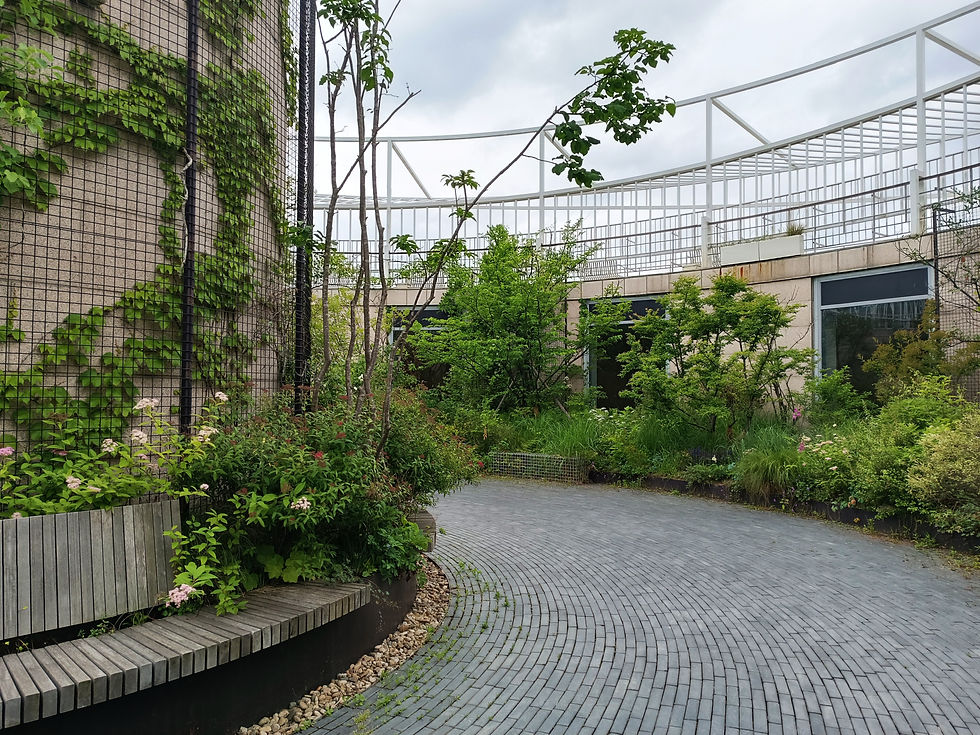
While words and photos can only hint at the atmosphere of this place, the best experience is to visit in person.
Meeting Legends: Nam June Paik, Lee Ufan, Kim Whanki
The heart of the museum stands “The More, The Better”, Nam June Paik's iconic six-tier video tower, composed of 1003 CRT monitors. Nam June Paik (1932–2006), born in Seoul but spending almost his life abroad, was the pioneer of video art, and this 18.5-meter tower was created for the museum during the 1988 Summer Olympics. For anyone familiar with Paik's works through books or at university, seeing them in person is unforgettable.
Visiting Gwacheon is a day-long course. Three exhibition floors, a rooftop overlooking the mountains and river, and outdoor spaces perfect for quiet reflection make the museum much more than just an exhibition venue. Visitors arriving by bus are also welcomed by Jonathan Borofsky's monumental kinetic sculpture “Singing Man” (1994), from whose constantly moving mouth a recorded artist's voice echoes across the grounds.

Through September 27, 2026, there is the exhibition “Road movie: Art between Korea and Japan since 1945", presenting works of Japanese contemporary artists and Korean artists, who, because of different circumstances, left Korea but remained attached to it, offering a deep insight into relations between Japan and Korea.
Right now, Lee Ufan’s (still active artist living in Japan) works are on view at the Biennale di Venezia (until November 22, 2026). At the same time, in Korea, they can be experienced at the MMCA, Leeum Museum in Seoul, and the dedicated Space Lee Ufan at the Museum of Contemporary Art in Busan. To deepen knowledge about the artistic worlds of Nam June Paik and Kim Whanki (1913–1974), one can visit the Nam June Paik Memorial House and the Whanki Museum, both located in Seoul.
At the museum entrance, Polish visitors may be pleasantly surprised by the sculpture “Androgyne and Wheels” (1988) by the internationally acclaimed Polish artist Magdalena Abakanowicz (1930–2017). Seeing her work in Korea is a reminder that art effortlessly crosses borders, connecting places, people, and cultures. The art speaks a language beyond words, age, profession, or nationality, making visible experiences that feel both universal and deeply personal.

A visit to the MMCA Gwacheon is the perfect activity for those who appreciate the harmony between nature and art. Across three floors of this beautiful building, designed by the renowned Korean-American architect Kim Tae-soo, visitors can spend a full day surrounded by Korean art.
I would like to express my gratitude to curator Yi Soojung, Joo Sunhae, and Park Saemin for inviting me to this magnificent art sanctuary, for our conversation, and for sharing their precious time and knowledge of art with me. I look forward to visiting Gwacheon next year.
Lee Ufan's painting "From Point": rectangular warm beige background and multiplied blue dots on it Lee Ufan's painting "From Line": rectangular warm beige background and blue lines paintend from to Black and white painting od a person in mask dancing with knives
Lee Ufan, "From Point", pigment on canvas, 1973, MMCA Collection.
Lee Ufan, "From Line", pigment on canvas, 1974, MMCA Collection.
Quac Insik, "Work 63", glass on panel, 1963, MMCA Collection.
Yun Hyongkeun, "Burnt Umber & Ultramarine", oil paint on hemp, 1976-177, MMCA Collection.
Kwak Duckjun, "World Map cut into 12 Equal Parts", oil ink on a map, 1970, private collection.
Lee Seungtaek, "Wind Series Drawings", watercolor and pencil on paper, 1971.
Hong Sungdam, "Gwangju Uprising in May Series – Dawn", woodcut on paper, 1988-1989.
Yun Sunknam, "Mother 2–Daughter and Son", acrylic paint and pastel on wood, photocopy on paper, 1992.
Lee Bul, "Sternbau No. 23", crystal, glass and acrylic beads on steel and bronze chain, nickel-chrome wire, stainless steel and aluminum armature, foamex, reflective film, acrylic mirror, stainless steel, aluminum and black nickel pipe, 2009.
Lee Yootae, "A Pair of Figures - Inquiry", color on paper, 1944.
Lee Yootae, "A Pair of Figures - Composing a Verse in Response", color on paper, 1944.
View of both of Lee Yootae's paintings.
Park Rehyun, "Mask", ink and color on paper, MMCA Lee Kun-hee Collection, 1958.
Gifts I received: a book of the MMCA collection, a collection of seasonal teas, a tiny blue bag, and a bokjumeoni – red lucky pouch.
Visitors viewing paintings in the gallery; some of them are resting on the couch.

Komentarze